By Bushra Humaira
In Bangladesh, women are facing a growing yet largely invisible crisis: environmental time poverty. This is the persistent lack of discretionary time caused by climate change and environmental stress, which intensifies women’s already heavy unpaid domestic and caregiving responsibilities.
While men often migrate for work or for income diversification, sometimes due to climatic stress, women are often left to manage households, secure water and fuel, care for sick family members, and maintain livelihoods, all of which are becoming more time-consuming as climate impacts worsen.
In a recent paper developed under the CGIAR Initiative on Asian Mega-Deltas project and published in Climate and Development, scientists from the International Rice Research Institute (IRRI) and Bangladesh Rice Research Institute (BRRI) adopted a systems approach to investigate the climate-gender-time poverty nexus, offering a framework for understanding Environmental Time Poverty (ETP).
Why it matters
ETP occurs when climate change, resource scarcity, and environmental degradation systematically increase the time women must spend on basic survival tasks such as fetching water, collecting fuel, cooking, and caring for family members. This leaves little to no discretionary time for education, income-generating activities, rest, or community participation. Gender norms and institutional barriers further amplify this burden, limiting women’s ability to adapt to climate challenges.
When women are pressed for time, they have fewer opportunities to learn and adopt climate-smart practices, engage in local decision-making, or participate in income-generating activities. Over time, this erodes their resilience to climate shocks and deepens gender inequality. The result is a self-reinforcing cycle where environmental stress and household responsibilities feed into each other, leaving women trapped in relentless time poverty.
What causes this?
- Water scarcity: Women and girls often walk long distances to fetch water, a task made harder by drought, flooding, and salinity.
- Energy crisis: Reliance on biomass fuels increases women’s labor in collecting firewood or managing household energy needs.
- Infrastructure damage: Flooded roads, damaged schools, disrupted healthcare, and unreliable electricity make even routine tasks more time-consuming.
- Health burdens: Climate-driven illnesses disproportionately increase women’s caregiving responsibilities.
- Adaptation strategies: Male outmigration and livelihood diversification can unintentionally add to women’s workload rather than reduce vulnerability.
What can be done?
The research warns that climate adaptation efforts that ignore women’s time constraints risk reinforcing inequality and maladaptation. Policies focused solely on assets, income, or infrastructure without recognizing unpaid care, and domestic work can unintentionally increase women’s workloads and deepen vulnerability. This research also emphasizes that climate adaptation must account for women’s unpaid work. Policy and practice can help in several ways:
- Recognize unpaid work as central to climate resilience: Women’s domestic and care responsibilities should be factored into climate vulnerability assessments.
- Invest in time-saving infrastructure: Piped water, clean energy, sanitation, transport, and healthcare can reduce women’s time burdens and improve their adaptive capacity.
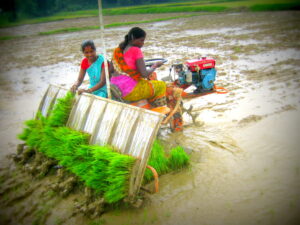
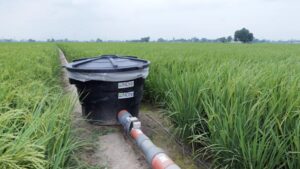
- Promote labor-saving, climate-smart technologies: Improved cookstoves, solar-powered irrigation, and water filtration systems should reduce rather than add to women’s workloads.
- Institutionalize time poverty in policy: Monitoring women’s time use in climate interventions ensures that adaptation strategies promote both resilience and gender equality.
Without addressing environmental time poverty, climate interventions risk reinforcing gender inequality and weakening women’s ability to cope with environmental stress. Ensuring women have time along with resources is central to building truly resilient communities in the face of climate change.
Read the study:
Mou Rani Sarker, Ranjitha Puskur, Md Abdur Rouf Sarkar
Unpacking the environment-gender-time poverty nexus in Bangladesh: insights from a systematic review.
Climate and Development, 1-21.
https://doi.org/10.1080/17565529.2025.2568853