- A season-long randomized-controlled field experiment found that financial rewards had a limited effect on reducing GHG emissions.
- The study also revealed that membership in cooperatives was more indicative of lower emissions.
- Researchers suggest that incentives be bundled with long-term technical and policy support, and stakeholder engagement.
By Glenn Concepcion
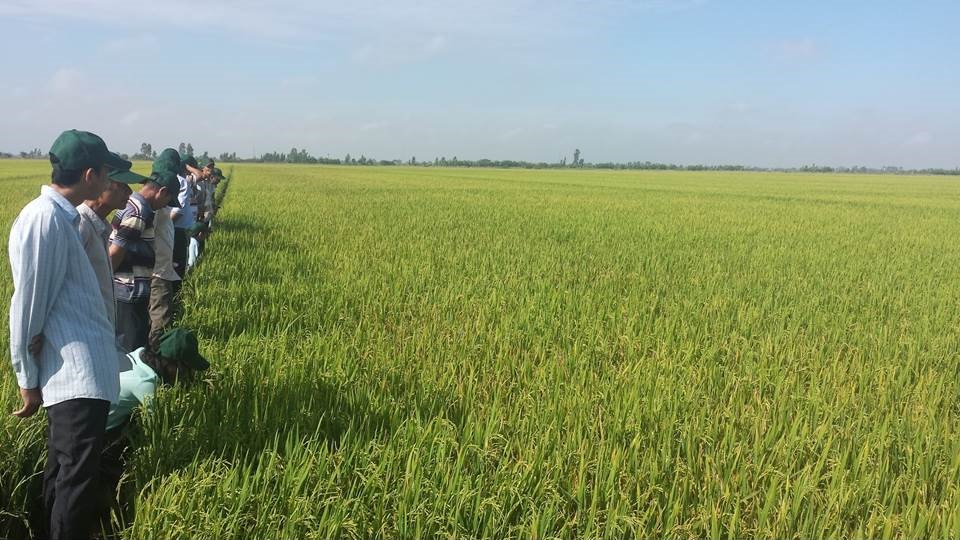
Growing rice is one of the most important food security and economic industries in Southeast Asia. In Vietnam’s Mekong Delta, which produces 50% of the nation’s rice and 90% of its rice exports, advances in agricultural intensification have helped nearly double rice production since 1995.
Vietnam’s rice production success has fueled economic growth and food security, but scaling agricultural output often involves environmental trade-offs. Rice cultivation is a significant contributor to greenhouse gas (GHG) emissions, particularly methane and nitrous oxide, which represent 5–20% of total global anthropogenic methane emissions. This is a big challenge for the Vietnamese government, which has committed to ambitious net-zero targets by 2050.
In a recent study published in Environmental and Sustainability Indicators, researchers from Can Tho University and the International Rice Research Institute simulated carbon credit payments to farmers in order to investigate whether results-based monetary incentives can effectively drive the behavioral changes necessary to propel the adoption and scaling up of low emission practices.
The experiment: rewarding reductions
In a field experiment involving 200 farmers in Vinh Thanh district, Can Tho City along the Mekong Delta, the researchers implemented the “One Must Do, Five Reductions” (1M5R) framework, an agronomic initiative that promotes the use of certified seeds while reducing seed rates, fertilizers, pesticides, water use, and postharvest losses. All farmer participants received training on 1M5R practices, but a “treatment group” was offered financial rewards: VND 500,000 (roughly $20) for reducing emissions by less than one ton of CO2e per hectare, and VND 1,000,000 for reductions exceeding that threshold.
The researchers employed rigorous statistical methods, including difference-in-differences regression and inverse-probability-weighted regression adjustment models alongside behavioral indicators (a change scale and a best practice scale) to analyze the impact of these incentives on GHG emissions.
Unexpected results
Despite the clear financial reward, the results were surprising. The study found that monetary incentives had a limited effect on reducing GHG emissions, with no statistically significant difference observed between the farmers who were paid and a control group that received only training. While the treatment group showed moderate improvements in reducing seed rates and nitrogen fertilizer use, the overall impact on GHG emissions was negligible during the season-long trial.
The study’s findings highlight the complex reality of farming. For many rice producers, the perceived risks and labor demands of adopting new technologies often outweigh a modest cash incentive. Furthermore, many farmers in the region had already reached a high baseline of adoption for certain practices, such as using combine harvesters, improved water management techniques, and use of certified seeds, meaning there was less room for the incentives to trigger dramatic new shifts.
Importantly, the researchers noted that a single cropping season is often insufficient to capture long-term adaptation. Climate-resilient farming is a skill that requires technical learning and management adjustments over multiple years. Without ongoing support, a one-time payment is unlikely to break through the structural and behavioral barriers that foster normative practices. Further, farmers do not inherently know which practices influence GHG emissions or how the complexity of interactions between practices drives changes in emissions, all of which hinders decision-making.
The answer is community, not cash
If money alone isn’t the answer, then what is? The study points toward a multi-stakeholder approach as the necessary catalyst for change.
One of the most significant findings was that membership in agricultural cooperatives was strongly linked to lower GHG emissions. Cooperative members emitted approximately 1.53 tons of CO2e per hectare less than non-members.
This suggests that cooperation between local organizations, government bodies, and technical experts creates an enabling environment that cash alone cannot replicate. When farmers are part of a collective, they gain better access to equipment, technical guidance, and shared social norms that encourage sustainability.
The researchers argue that for climate-resilient practices to truly take root, incentive programs must be bundled with broader support systems. This includes:
- Technical assistance: Incentives are more effective when paired with extension services that help farmers troubleshoot new methods like Alternate Wetting and Drying (AWD).
- Local stakeholder engagement: Engaging community leaders and cooperatives helps build the trust and social capital necessary to change long-standing farming habits.
- Behavioral nudges: Beyond monetary rewards, policymakers should use social norm messaging and public recognition to frame low-emission farming as a prestigious community standard.
- Robust monitoring: Transparent Monitoring, Reporting, and Verification (MRV) systems are essential to ensure that emission reductions are real and that rewards are distributed fairly.
All together for low-emission cultivation
The study underscores that while monetary incentives are a valuable component of climate policy, they are insufficient as a standalone solution. The transformation of the Mekong Delta’s rice sector will require integrated policy frameworks that account for farmer heterogeneity and prioritize cooperation between scientists, government bodies, and local cooperatives. By fostering a unified front that addresses the socio-economic and structural barriers to adoption, Vietnam can more effectively move toward its goal of high-quality, low-emission rice production.
Read the study:
Ong Quoc Cuong, Trang Vu, Ly Trung Nguyen, Nguyen Bao Tran, Bjoern Ole Sander, Katherine M. Nelson
Do conditional monetary incentives drive behavioral changes and reduce greenhouse gas emissions in rice production? Evidence from a field experiment in the Mekong Delta, Vietnam
Environmental and Sustainability Indicators, Volume 30, 2026
https://doi.org/10.1016/j.indic.2026.101178