By Hom Gartaula, Alice Laborte, and Jon Hellin
International Rice Research Institute (IRRI), Los Baños, Philippines

This is a continuation of the two-part blog on the Inclusive Innovation and Impactful Scaling (I3S) framework.
The I3S framework builds on STIBs and broader responsible scaling work to offer a structured way of thinking about inclusive innovation in rice‑based systems. It has four core pillars, supported in turn by six enabling systems.
Four pillars
- Co‑design and responsible mechanization
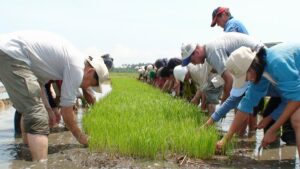
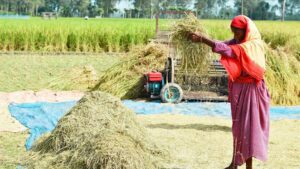
Mechanization can reduce drudgery and address labor shortages, but only if equipment is ergonomically designed, affordable, and integrated into inclusive service models. Research across Asia and the Philippines shows that gender‑blind mechanization can shift labor burdens or bypass women entirely. Responsible mechanization begins by asking women and men farmers what problems they need to be solved and involving them in the design, testing, scheduling, and training (Devkota et al., 2020; Damayon et al., 2025).
- Climate adaptation and resilience
Climate change is not gender‑neutral. Women and poorer households are often disproportionally vulnerable to typhoons, droughts, and price shocks, even though they have vital knowledge on diversified cropping, home gardens, and social networks (Huyer et al., 2024). Evidence from India indicates that bundling climate‑smart practices with women’s groups and norm‑change work leads to more durable adaptation and empowerment1. In the Philippines, initiatives like Guinayangan’s Climate‑Smart Village point in this direction but need stronger attention to gendered risk and decision‑making2, 3.
- Inclusive seed systems
Women in many Philippine rice communities play central roles in seed selection, storage, and varietal diversity, yet often lack a voice in formal seed programs (DOST-PCAARRD, 2021). Studies from other regions suggest that women’s varietal preferences, which usually prioritize processing quality, taste, or multipurpose biomass, differ from those of men and can be overlooked by breeders if not systematically documented (Gartaula et al., 2024). Inclusive seed systems recognize women as co‑decision‑makers, support women‑led seed enterprises and community seed banks, and require disaggregated trait preference data in breeding.
- Socio‑technical innovation bundles (STIBs)
This pillar operationalizes the idea that technology must be coupled with social and institutional change. Bundles may link stress‑tolerant varieties with crop insurance and women’s savings groups or combine drones for fertilizer application with training for women drone service providers and safeguards for labor impacts (Johnstone et al., 2023). The aim is to avoid a one‑size‑fits‑all package and create adaptable combinations that respond to local livelihood systems.
Six enabling systems
The four pillars are supported by six systems: (1) adequate resources (finance and technology), (2) mixed research methods and socially disaggregated data (by gender, age, location, and social organization), (3) capacity development, (4) participation and stakeholder engagement, (5) equity, and (6) wellbeing. When implemented together, they align R4D, extension, and policy instruments toward inclusive, context‑sensitive, and transformative scaling.
How I3S can guide a more inclusive Philippine rice agenda
Applying I3S and STIBs in the Philippines would mean re‑orienting rice R4D and policy around a few practical shifts:
Co‑designing with diverse farmer segments. National and provincial programs can institutionalize participatory diagnostics (in terms of risk and vulnerability mapping and social equity contexts) before rolling out technologies. Living labs similar to those used in STIBs’ work, could convene women and men farmers, youth, local governments, NGOs, and private actors to co‑design bundles tailored to, for example, irrigated, rainfed, and upland systems (Bhatta et al., 2025).
Collecting and analyzing sex‑ and socially disaggregated data. The AR4D organizations can align monitoring with gender‑transformative CSA and STIBs indicators, tracking who accesses seed, machinery, training, and market opportunities, and how workloads and decision‑making change.
Investing in responsible mechanization and seed systems. Mechanization roadmaps can require gender‑responsive design and inclusive service models, including support for women‑operated machinery services and gender‑friendly training schedules. Seed programs can mandate inclusion of women’s trait preferences and support community‑based seed enterprises led by women and youth, particularly in climate‑vulnerable areas.
Bundling technologies with social and institutional innovations. The projects and programs can explicitly identify the social, financial, and policy elements that need to accompany each technical intervention and resource them accordingly, for example, linking stress‑tolerant varieties to crop insurance and women’s savings groups, or by pairing drones with youth‑led service enterprises and labor safeguards.
Strengthen institutional capacity and incentives. Government agencies and research institutes can incorporate participatory, gender‑transformative approaches into staff training, appraisal, and budgeting, ensuring that inclusive practices are not dependent on individual champions.

A call to action
Experiences from Guinayangan’s Climate‑Smart Village, RiceBIS community enterprise models, local government-led value chain initiatives, and women‑focused climate‑smart investments already show what inclusive, locally rooted innovation can look like. Work by many AR4D organizations at the national and international levels on bundling solutions (such as STIBs) and gender‑transformative adaptation offers tested tools and frameworks to build on.
The challenge now is to move from isolated islands of success to system-level change. This calls for policymakers to view scaling not simply replicating predefined solutions, but as a process that involves adjusting roles, responsibilities, and benefits among stakeholders.
If national rice programs adopt I3S principles, co‑design, gender‑transformative data and approaches, social readiness, interdisciplinary collaboration, contextual embedding, and investment in equity and wellbeing, public spending can do more than raise yields. It can help build a rice sector where women and men smallholders are resilient, empowered, and central to shaping the technologies and institutions that affect their lives.